
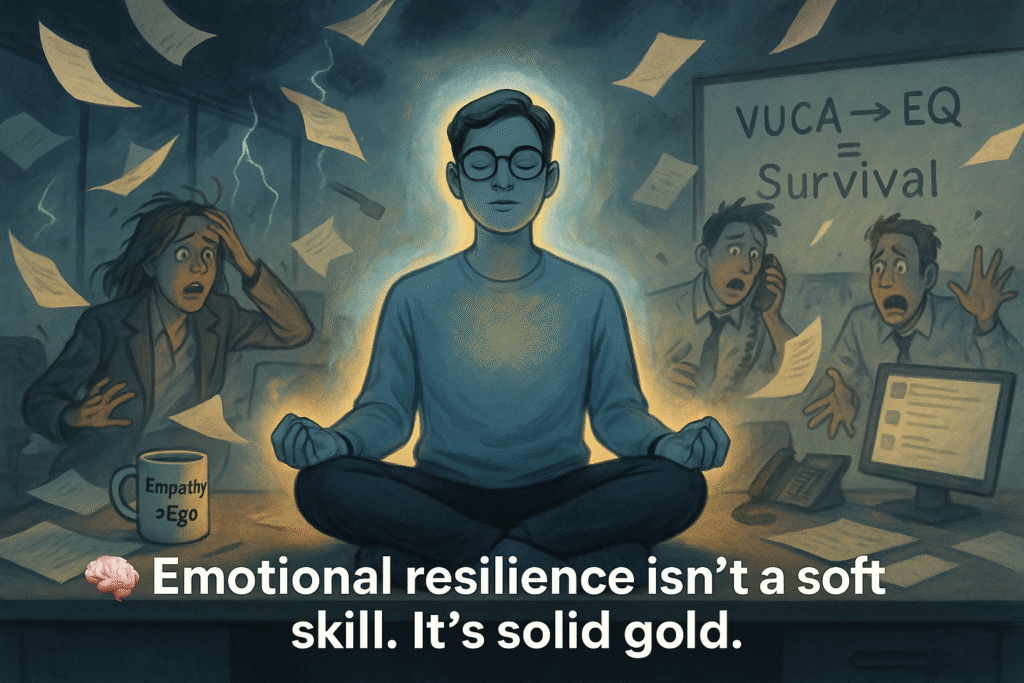
Let’s take a beat and talk about leadership.
Not the kind that leads with spread sheets. Or the kind that thinks culture is a ping-pong table and a Slack emoji. I’m talking about the kind of leadership that actually works in the world we live in now — the one full of curveballs, fog, and “Did that just happen again?!”
Because here’s the truth bomb: The best leaders — the ones building resilient teams, growing against all odds, and not spontaneously combusting on LinkedIn — share one thing.
Yep, the successful ones don’t have the same demographics : not the same degree. Not the same business model. Not even the same timezone.
They all have high emotional intelligence and stronger-than-your-coffee emotional resilience.
Why that matters (now more than ever)?
Each of us could go on and on on stressors of our times and how it has affected outcomes
We used to think experience was everything. And it still matters. But let’s be honest: what got us here won’t get us through the next uncertainty-shaped iceberg. The old playbooks are in the recycling bin.
What we need now? Leaders who know how to hold steady in the storm. Who can read the room and read the moment. Who know how to be calm when it feels like everything’s on fire (emotionally speaking, of course).
Enter: Emotional resilience. The superpower for this season.
What the data (and a few smart people in suits) are telling us?
Harvard Business Review, Deloitte, McKinsey & Co. — all those lovely folks in sharp blazers — have said it loud and clear and not the just the suits, Emotional Intelligence is what has been alluded to in treatises like Chanukya Niti , the Bhagawath Geetha , stories of the Mahabharath where it is the calm and empathetic leadership that has always won
How do we identify them?
Emotionally intelligent and resilient leaders:
* Navigate uncertainty like a GPS with intuition
* Make decisions under pressure without turning into a stress volcano
* Lead with empathy, not ego
* Keep teams energized, even when everything feels… extra
In a world that’s VUCA (Volatile, Uncertain, Complex, Ambiguous), emotional agility is your cheat code. Translation? When things get weird, emotionally grounded leaders don’t just survive — they thrive.
Numbers that speak louder than a keynote slide-
* 90% of top performers have high EI → Translation: Emotional intelligence = top-tier leadership
* 38% better decision-making under pressure → Calm > chaos
* 3.5x more likely to lead high-performing teams → Emotional safety = creative bravery
* 25% lower burnout → Because emotional regulation isn’t just yoga and green juice
* 40% less turnover → People don’t leave managers who genuinely care
Empowered leaders and engaged teams create lasting impact.
Yes, it is a skill or trait , and can be carefully cultured or honed .
Real stories, real proof
Satya Nadella at Microsoft
When he took over in 2014, Microsoft was a little… stiff. Rigid. Losing steam. But Nadella brought in empathy, humility, and a human-first mindset. The result? Culture shift. Innovation revival. A market cap glow-up from $300B to $2.5T.
“Empathy makes you a better innovator.” (Put that on a coffee mug.)
Jacinda Ardern, former PM of New Zealand
During crises — from terrorist attacks to a global pandemic — Ardern led not with power-posing, but with presence. With emotional honesty. With human-ness.
Her message? “You can be strong, and you can be kind.” (Mic drop.)
Howard Schultz, Starbucks CEO (Redux)
In 2008, he shut down every store nationwide — not because of a latte shortage, but because the culture needed a reboot. Emotional intelligence training became the new espresso shot.
What happens when leaders… don’t?
Uber under Travis Kalanick
Aggressive growth, zero empathy, and a toxic bro culture. Spoiler alert: It didn’t end well.
WeWork under Adam Neumann
Charisma? Yes. Emotional grounding? Not so much. Cue: chaos, overpromises, and a spectacular IPO fail.
BP’s Deepwater Horizon
During one of the worst environmental disasters, the CEO said, “I want my life back.” Oof. If emotional tone-deafness were a currency, this would’ve been a billion-dollar headline (and lawsuit).
Closer to home: Byju’s crash course in what not to do
🚨 They chased growth like it was the only KPI.
🚨 They ignored the soul of the company: its people.
🚨 They deflected blame and dodged accountability.
🚨 They eroded trust faster than you can say “independent audit.”
It wasn’t just a business misstep. It was an emotional blind spot in full view.
Conclusion:
Let’s land this with the most important takeaway: The cost of ignoring emotional intelligence isn’t just lower performance.
It’s cultural erosion. Team fatigue. Brand disintegration. And when the pressure hits, those cracks? They become canyons. Because in a world where the only constant is chaos, emotional resilience isn’t a “soft skill.” It’s solid gold.
Let’s build leaders who can hold the hard stuff, who show up with clarity, who lean into empathy without losing effectiveness.
Let’s build leaders who are deeply, relentlessly… human.